




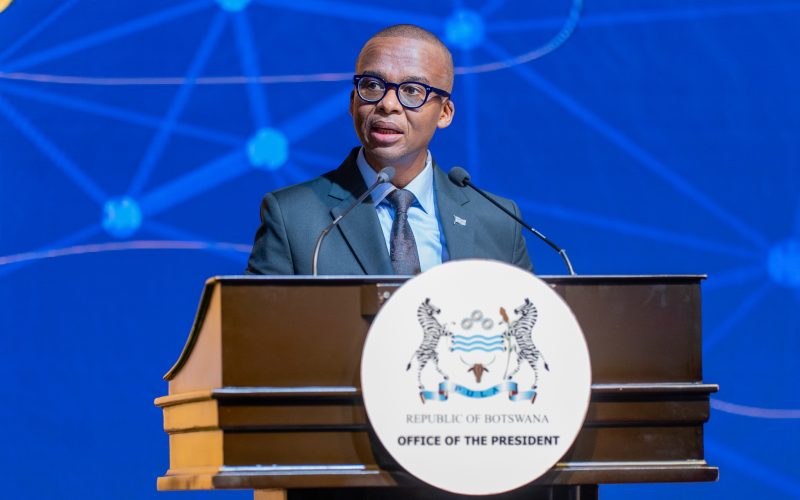
Botswana must transform its mining wealth into industrial capacity, globally competitive businesses and sustainable economic opportunities if the country is to secure prosperity beyond the lifespan of its mineral resources, Vice President and Minister of Finance Ndaba Gaolathe has said.
Gaolathe said Botswana is entering a critical phase in its economic development where the focus must shift from extracting minerals to using mining revenues and capabilities as a foundation for diversification, industrialisation and long-term economic resilience.
Delivering a keynote address at the Future of Mining Summit 2026 organised by Projects Magazine, Gaolathe said the country’s next economic chapter would depend on its ability to convert mineral wealth into productive industries, skilled human capital and globally competitive enterprises.
Addressing policymakers, investors, mining executives and development partners, he said Botswana’s economic transformation must move beyond the traditional dependence on diamonds and position mining as a catalyst for broader economic growth.
“Every nation has defining moments,” Gaolathe said, describing independence and the discovery of diamonds as two major turning points in Botswana’s history.
Since commercial diamond mining began in 1971, Botswana has produced more than 700 million carats of diamonds, generating revenues that have financed infrastructure development, healthcare, education and public institutions while transforming the country from one of the world’s poorest nations into an upper-middle-income economy.
However, Gaolathe said Botswana now faces a new challenge: ensuring that the prosperity created by mining becomes the foundation for an economy capable of thriving beyond mineral extraction.
“The question is no longer whether diamonds transformed Botswana. They did. The question now is whether the prosperity created by mining can become the foundation of an economy capable of thriving long before the last mine has been mined,” he said.
He challenged the country to consider what it will build before its mineral resources decline. “What will Botswana build before the shafts fall silent?” he asked. Gaolathe said Botswana’s first economic miracle came from the resources beneath the ground, but the next phase of growth would depend on the country’s ability to create value from those resources through industrial development, innovation and entrepreneurship.
“The first miracle came from what lay beneath our feet. The second miracle will come from the discoveries Botswana is capable of making by leveraging the minerals we found in the first place,” he said.
He said mining must continue to play a strategic role in Botswana’s economy, but its purpose must evolve from being the foundation of growth to becoming a driver of a diversified and resilient economy.
Central to Gaolathe’s address was the Botswana Economic Transformation Programme (BETP), which he described as government’s framework for delivering economic transformation through coordinated implementation.
He said the programme was designed to move beyond policy commitments by providing a practical mechanism to align government, the private sector, development partners and institutions around measurable improvements in investment, productivity, implementation and employment creation.
“The BETP is Botswana’s national operating system for economic transformation,” Gaolathe said.
He said the programme translates the objectives of National Development Plan 12 into an implementation-focused blueprint aimed at accelerating economic growth and removing structural barriers.
Following a nationwide call for proposals, government received nearly 7,000 submissions from citizens, businesses and stakeholders. From these, 186 transformational initiatives were selected based on their potential to unlock investment, address economic bottlenecks and create new growth opportunities.
The initiatives are focused on six priority sectors identified as future economic drivers: mining and energy, agriculture, manufacturing, tourism, financial services, and digitalisation and infrastructure. These sectors will be supported by three foundational pillars — health, education and social protection — which government views as critical to building a competitive workforce and sustainable economy.
Gaolathe said the initiatives have the potential to mobilise more than P500 billion in investment and create more than 500,000 jobs, supporting Botswana’s transition into a high-income, export-oriented and digitally enabled economy. He also called for a broader definition of mining success, arguing that the sector should no longer be measured only through mineral production and export earnings.
According to Gaolathe, mines must become anchors of wider industrial ecosystems that stimulate manufacturing, technology, logistics, engineering services, skills development and local enterprise growth.
He said beneficiation should not be limited to processing minerals domestically, but should include efforts to retain greater economic value through industrialisation, innovation, enterprise development and stronger citizen participation across mining value chains. For Botswana, he said, the future of mining lies not only in what is extracted from the ground, but in what the country builds from the opportunities created by those resources.